Saving this page to a PDF file.
Chrome
Step 1: Click the "Print this page" button. Alternatively, press Ctrl + P (on Mac, use Cmd + P)
Step 2: In the resulting pop-up window, click the Down Arrow to the right of Destination and select Save As PDF in the drop-down menu. You can also optionally choose to hide 'Headers and Footers' with a checkbox.
IE/Edge
Step 1: Click the "Save / print page" button. Alternatively, press Ctrl + P (on Mac, use Cmd + P)
Step 2: On the following dialog, under Printer, choose 'Microsoft Print to PDF'
Click 'Print' and you have saved your webpage to a PDF file.

Cough and cold
Coughs and colds are extremely common in children. Over the first few years of life, your child might have these every month.
- Coughing is the body's natural way of clearing infection
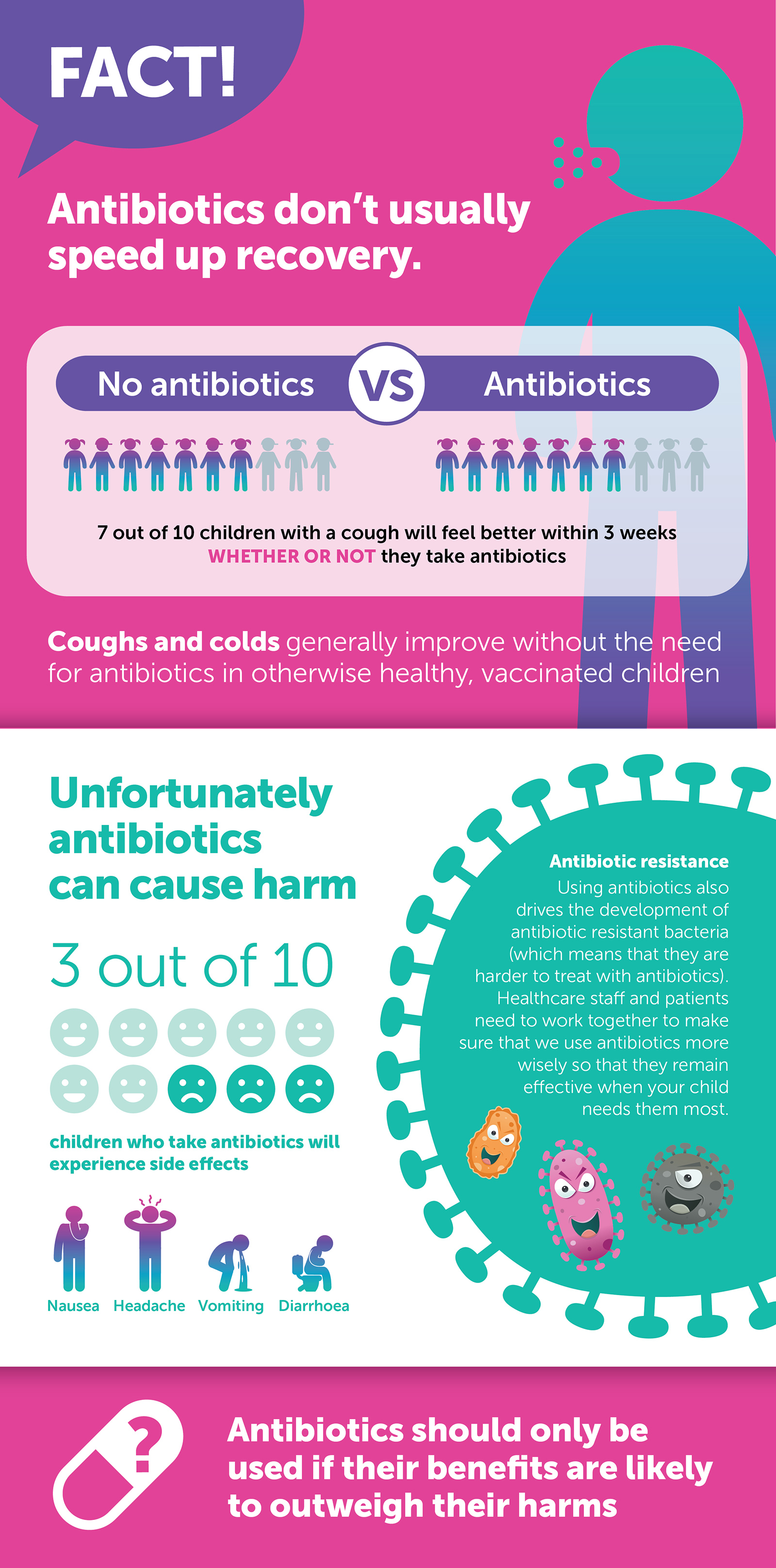
- Most of these are likely to be caused by a virus, which means that antibiotics don’t help. Antibiotics might cause side effects such as rash and diarrhoea, or increase the risk of developing antibiotic resistance.
- Having green snot or a noisy chest does not mean that your child has an infection needing antibiotics
- Coughing can wake a child in the night but does not mean the illness is more severe
When should you worry?
If your child has any of the following:
- Breathing very fast or breathing that stops or pauses
- Makes a grunting noise every time they breathe out
- A harsh noise as they breathe in (stridor) present all of the time (even when they are not upset)
- Becomes pale, blue, mottled and / or unusually cold to touch
- Difficult to wake up, very sleepy or confused
- Has a fit (seizure)
- Has a rash that does not go away with pressure (the glass test)
You need urgent help
Go to the nearest Hospital Emergency (A&E) Department or call 999 - consider using ‘What 3 words’ to best describe location to ambulance service.
If your child has any of the following:
- Working hard to breathe, drawing in of the muscles below the ribs
- A harsh noise as they breathe in (stridor) only when upset
- Dry skin, lips or tongue
- Not had a wee or wet nappy in last 8 hours
- Not drinking
- Irritable (Unable to settle them with toys, TV, food or hugs even after their fever has come down)
- Temperature of 38oC or above for more than 5 days or shivering with fever (rigors)
- Temperature less than 36°C
- Getting worse and I am still worried
You need to contact a doctor or nurse today
Please contact your GP practice or call NHS 111.
If symptoms persist for 4 hours or more and you have not been able to speak to either a member of staff from your GP practice or to NHS 111 staff, recheck that your child has not developed any red features.
If none of the above features are present
- Watch them closely for any change and look out for any red or amber symptoms
- If your child has a long term condition or disability and you are worried please contact your regular team or follow any plans that they have given you.
Self care
Continue providing your child’s care at home. If you are still concerned about your child, speak to your health visitor, local pharmacist or NHS 111.
Children and young people who are unwell and have a high temperature should stay at home. They can go back to school, college or childcare when they no longer have a high temperature, and they are well enough to attend.
What should you do?
- Keep your child well hydrated by offering them lots to drink.
- Most children with coughs and colds do not require treatment with antibiotics.
- If your child seems to be in pain or discomfort, you can give your child Paracetamol or Ibuprofen, following the instructions on the container.
- Do not give cough syrup. It is not recommended for children under 6 years. It can make children sleepy and does not help.
- Try using saline nose drops or spray if your baby has a blocked nose.
- For children over 1 year, a spoon of honey (perhaps in a warm drink) half an hour before bed may help them to wake less often in the night.
- For children over 2 years, vapour rubs (containing camphor, menthol and/or eucalyptus) may help children sleep better.
How long will your child's symptoms last?
- Coughs and colds can continue for weeks before they get better.
- Over the winter, children are likely to get one viral infection after another, which can make you think that they are never well. Things will get better in the summer months.
- Having a cough for 2 or 3 weeks does not mean that your child needs antibiotics.
- Children under 2 years of age with breathing difficulty may have bronchiolitis. This is a common condition that usually starts as a runny nose and cough, but their breathing may get worse over the next 2-3 days.
- If your child has noisy breathing, they might have croup.
Treatment
Most children with coughs/colds do no require treatment with antibiotics. Antibiotics rarely speed up recovery and often cause side effects such as rash and diarrhoea. They will also promote the development of antibiotic resistant bacteria in your child.
Prevention
-
It is not always easy to avoid catching these infections. However, good hygiene practices can prevent infections spreading
- Wash your hands regularly and thoroughly
- Use a tissue when coughing or sneezing and put it in the bin
- Avoid sharing glasses or utensils with people who are unwell
Where should you seek help?
- If it is non-urgent, speak to your local pharmacist or health visitor.
- If your child has any of the above features, urgently see your GP. For an urgent out-of-hours GP appointment, visit NHS 111 Online or for children under 5 call 111
- You should only call 999 or go to your nearest A&E department in critical or life threatening situations.
For wear and tear, minor trips and everything in between.
Self-care
You can treat your child's very minor illnesses and injuries at home.
Some illnesses can be treated in your own home with support and advice from the services listed when required, using the recommended medicines and getting plenty of rest.
Sound advice
Children can recover from illness quickly but also can become more poorly quickly; it is important to seek further advice if a child's condition gets worse.
For information on common childhood illnesses go to What is wrong with my child?
Health visitors are nurses or midwives who are passionate about promoting healthy lifestyles and preventing illness through the delivery of the Healthy Child Programme. They work with you through your pregnancy up until your child is ready to start school.
Health Visitors can also make referrals for you to other health professionals for example hearing or vision concerns or to the Community Paediatricians or to the child and adolescent mental health services.
Contact them by phoning your Health Visitor Team or local Children’s Centre.
Sound advice
Health visitors also provide advice, support and guidance in caring for your child, including:
- Breastfeeding, weaning and healthy eating
- Exercise, hygiene and safety
- Your child’s growth and development
- Emotional health and wellbeing, including postnatal depression
- Safety in the home
- Stopping smoking
- Contraception and sexual health
- Sleep and behaviour management (including temper tantrums!)
- Toilet training
- Minor illnesses
For more information watch the video: What does a health visitor do?
School nurses care for children and young people, aged 5-19, and their families, to ensure their health needs are supported within their school and community. They work closely with education staff and other agencies to support parents, carers and the children and young people, with physical and/or emotional health needs.
Primary and secondary schools have an allocated school nurse – telephone your child’s school to ask for the contact details of your named school nurse.
There is also a specialist nurse who works with families who choose to educate their children at home.
Sound Advice
Before your child starts school your health visitor will meet with the school nursing team to transfer their care to the school nursing service. The school nursing team consists of a school nursing lead, specialist public health practitioners and school health staff nurses.
They all have a role in preventing disease and promoting health and wellbeing, by:-
- encouraging healthier lifestyles
- offering immunisations
- giving information, advice and support to children, young people and their families
- supporting children with complex health needs
Each member of the team has links with many other professionals who also work with children including community paediatricians, child and adolescent mental health teams, health visitors and speech and language therapists. The school health nursing service also forms part of the multi-agency services for children, young people and families where there are child protection or safeguarding issues.