- Keep monitoring your child for red and amber features (see above). Seek help if they develop, as this may suggest a more severe illness requiring specific investigations and treatment.
- Keep your child as comfortable as possible. Consider giving paracetamol or ibuprofen for comfort.
- Offer them simple food and regular drinks.
- If they are vomiting, offer small frequent drinks as this is more likely to stay down.
- Do not try to control your child’s temperature with tepid sponging or fans.
- Keep an eye on your child day and night and follow the guidance overleaf. If a rash appears do “the glass test” (see guidance overleaf).
- If your child is due their vaccinations, postpone until after their fever has improved.
- Notify their school if you need to keep your child away while they are unwell and have a fever – see Healthier Together website for advice if you are unsure whether they need to be kept off school or not.

Fever and High Temperature
Fever is extremely common in children and usually suggests that your child has an infection. It's really important that you measure your child's temperature accurately - you should use a digital thermometer (under the the armpit (axillary) for children 5 years and younger, and in the mouth for children over 5 years of age). The other option is to use an in the ear thermometer (tympanic), although these should not be used in babies below a month of age.
- Viral infections are far more common than bacterial infections
- Symptoms such as runny nose, cough, wheeze, sore throat, red eyes and diarrhoea are more suggestive of a viral infection than a bacterial infection. If a number of people are unwell in the same household, this also suggests a viral infection (because viral infections are easily spread)
- Fever is common in babies up to 48 hours after receiving immunisations - it is okay to give paracetamol after the MenB vaccine without seeking medical advice if your baby is otherwise well
- Occasionally, children with fever can have a seizure/fit. This is called a febrile convulsion and most commonly occurs in children aged between 6 months and 3 years. They generally occur on day 1 of the fever, and in most cases have no long term effects
- Viral infections tend to get better on their own and do not need treatment with antibiotics. Antibiotics may actually cause side effects such as rash and diarrhoea and can increase the risk of them developing antibiotic resistance
- Information on Covid-19 can be found here
Operation Ouch - Fever
When should you worry?
If your child has any of the following:
- Breathing very fast, too breathless to talk, eat or drink
- Working hard to breathe, drawing in of the muscles below the ribs, or noisy breathing (grunting)
- Breathing that stops or pauses
- Is pale, blue, mottled or feels unusually cold to touch
- Difficult to wake up, very sleepy or confused
- Has a fit (seizure)
- Has a rash that does not disappear with pressure (perform the glass test)
You need urgent help
Go to the nearest Hospital Emergency (A&E) Department or call 999 - consider using ‘What 3 words’ to best describe location to ambulance service
If your child has any of the following:
- Temperature of 38°C or above for more than 5 days or shivering with fever (rigors)
- Temperature less than 36°C
- Breathing a bit faster than normal or working a bit harder to breathe
- Dry skin, lips or tongue
- Not had a wee or wet nappy in last 8 hours
- Not drinking
- Irritable (Unable to settle them with toys, TV, food or hugs even after their fever has come down)
- Swelling of a limb or joint
- Not using or putting weight on an arm, leg, hand or foot
- Complaining of severe pain that is not improving with painkillers
- Has had chickenpox in the past few days and is now getting worse with a high fever or spreading red rash
- Getting worse and you are worried
You need to contact a doctor or nurse today
Please contact your GP practice or call NHS 111
If symptoms persist for 4 hours or more and you have not been able to speak to either a member of staff from your GP practice or to NHS 111 staff, recheck that your child has not developed any red features.
If none of the above features are present
- Watch them closely for any change and look out for any red or amber symptoms
- If your child has any other symptoms associated with their fever, you may want to look at the information on sore throat, cough, earache, diarrhoea and vomiting or tummy ache or our other pathways
- If your child has a long term condition or disability and you are worried please contact your regular team or follow any plans that they have given you
Self care
Continue providing your child’s care at home. If you are still concerned about your child, speak to your health visitor, local pharmacist or call NHS 111.
Keep monitoring your child for red and amber features and seek help if they develop
Children and young people who are unwell and have a high temperature should stay at home. They can go back to school, college or childcare when they no longer have a high temperature, and they are well enough to attend.
Most children with a fever do get better very quickly but some children can get worse. You need to regularly check your child during the day and also through the night and follow the advice given below.
- Fever is extremely common in children and usually suggests that your child has an infection.
- Your child has a fever if their temperature is over 38°C. The most accurate way of measuring your child’s temperature is with a digital thermometer.
- Viral infections are far more common than bacterial infections. Symptoms such as runny nose, cough, wheeze, sore throat, red eyes and diarrhoea are more suggestive of a viral infection than a bacterial infection. If a number of people are unwell in the same household, this also suggests a viral infection.
- Viral infections tend to get better on their own and do not need treatment with antibiotics.
- During a viral illness we would expect to see ongoing temperatures for 2-3 days and then a slow and gradual improvement of symptoms. If your child becomes more unwell after a period of initial improvement, then seek medical input.
- If your child is distressed you should consider giving them paracetamol or ibuprofen to help them feel more comfortable. Use one and if your child has not improved 2-3 hours later you may want to try giving the other medicine.
- Carefully read the instructions on the medicine for dose and frequency.
- You could ask your local pharmacist for more advice about medicines.
- In general, we do not recommend cough medicines.
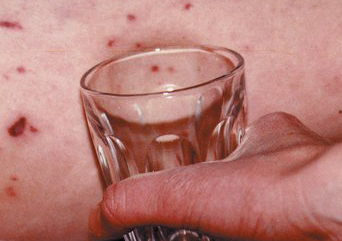
Do the ‘glass test’ if your child has a rash. Press a glass tumbler firmly against the rash. If you can see the spots through the glass and they do not fade as you press the glass onto the skin then this is called a ‘non-blanching rash’. If you see this type of rash, seek medical advice immediately. The rash is harder to see on dark skin so check paler areas, such as palms of the hands, soles of the feet and tummy.
(Photo courtesy of the Meningitis Research Foundation 2013)
Where should you seek help?
- If it is non-urgent, speak to your local pharmacist or health visitor.
- If your child has any of the above features, urgently see your GP. For an urgent out-of-hours GP appointment, visit NHS 111 Online or for children under 5 call 111
- You should only call 999 or go to your nearest A&E department in critical or life threatening situations.
Health visitors are nurses or midwives who are passionate about promoting healthy lifestyles and preventing illness through the delivery of the Healthy Child Programme. They work with you through your pregnancy up until your child is ready to start school.
Health Visitors can also make referrals for you to other health professionals for example hearing or vision concerns or to the Community Paediatricians or to the child and adolescent mental health services.
Contact them by phoning your Health Visitor Team or local Children’s Centre.
Sound advice
Health visitors also provide advice, support and guidance in caring for your child, including:
- Breastfeeding, weaning and healthy eating
- Exercise, hygiene and safety
- Your child’s growth and development
- Emotional health and wellbeing, including postnatal depression
- Safety in the home
- Stopping smoking
- Contraception and sexual health
- Sleep and behaviour management (including temper tantrums!)
- Toilet training
- Minor illnesses
For more information watch the video: What does a health visitor do?
School nurses care for children and young people, aged 5-19, and their families, to ensure their health needs are supported within their school and community. They work closely with education staff and other agencies to support parents, carers and the children and young people, with physical and/or emotional health needs.
Primary and secondary schools have an allocated school nurse – telephone your child’s school to ask for the contact details of your named school nurse.
There is also a specialist nurse who works with families who choose to educate their children at home.
Sound Advice
Before your child starts school your health visitor will meet with the school nursing team to transfer their care to the school nursing service. The school nursing team consists of a school nursing lead, specialist public health practitioners and school health staff nurses.
They all have a role in preventing disease and promoting health and wellbeing, by:-
- encouraging healthier lifestyles
- offering immunisations
- giving information, advice and support to children, young people and their families
- supporting children with complex health needs
Each member of the team has links with many other professionals who also work with children including community paediatricians, child and adolescent mental health teams, health visitors and speech and language therapists. The school health nursing service also forms part of the multi-agency services for children, young people and families where there are child protection or safeguarding issues.